
Cadaviz Technology
Transforming Real Human Anatomy into Interactive Medical Learning.
Cadaviz Technology integrates medical imaging, real anatomy data, computer vision, three-dimensional reconstruction, anatomical science, and scientific visualization into a unified digital workflow. Every Cadaviz body is developed from real human cadavers through expert-driven reconstruction, annotation, validation, and quality assurance processes, ensuring exceptional anatomical fidelity and educational value.
Technology Pipeline
Cadaviz proprietary technology is a scientifically validated workflow that captures anatomical information at multiple levels, reconstructs it into a high-fidelity digital body, and delivers an immersive platform for anatomy education, clinical training, and biomedical research.
Real Human Cadaver Data Acquisition
Cadaviz bodies are sourced from ethically donated real human cadaver data. A comprehensive multimodal imaging workflow captures the anatomical information required for accurate digital human body generation.
CT Imaging
High-resolution CT captures skeletal anatomy and overall body morphology, while contrast-enhanced CT enhances the visualization of arteries, veins, and tissue interfaces, providing precise structural information and preserving the three-dimensional organization of anatomical structures.
MRI
MRI provides exceptional soft tissue contrast, enabling detailed visualization of muscles, ligaments, tendons, nerves, organs, cartilage, and connective tissues. The MRI datasets complement CT by accurately representing soft tissue anatomy throughout the body.
Surface Topography
High-resolution surface topography acquisition captures the external geometry, anatomical contours, and surface morphology of the cadaver, preserving external anatomical features and providing the foundation for realistic body surface reconstruction.
Image Processing
CT, MRI, and surface datasets undergo image enhancement, normalization, and spatial registration to create a unified three-dimensional coordinate system. This ensures accurate alignment and preserves anatomical relationships throughout the reconstruction process.
3D Reconstruction
Following registration, the integrated datasets are reconstructed into a volumetric three-dimensional anatomical model. Advanced reconstruction algorithms preserve anatomical geometry, tissue continuity, organ morphology, and spatial relationships, generating a faithful digital representation of the original cadaver.
Anatomical Annotation
Expert anatomists systematically identify, verify, and annotate anatomical structures using internationally accepted anatomical terminology. Each structure is assigned standardized metadata that supports anatomical search, educational content, clinical reference, and interactive visualization.
Texture Mapping
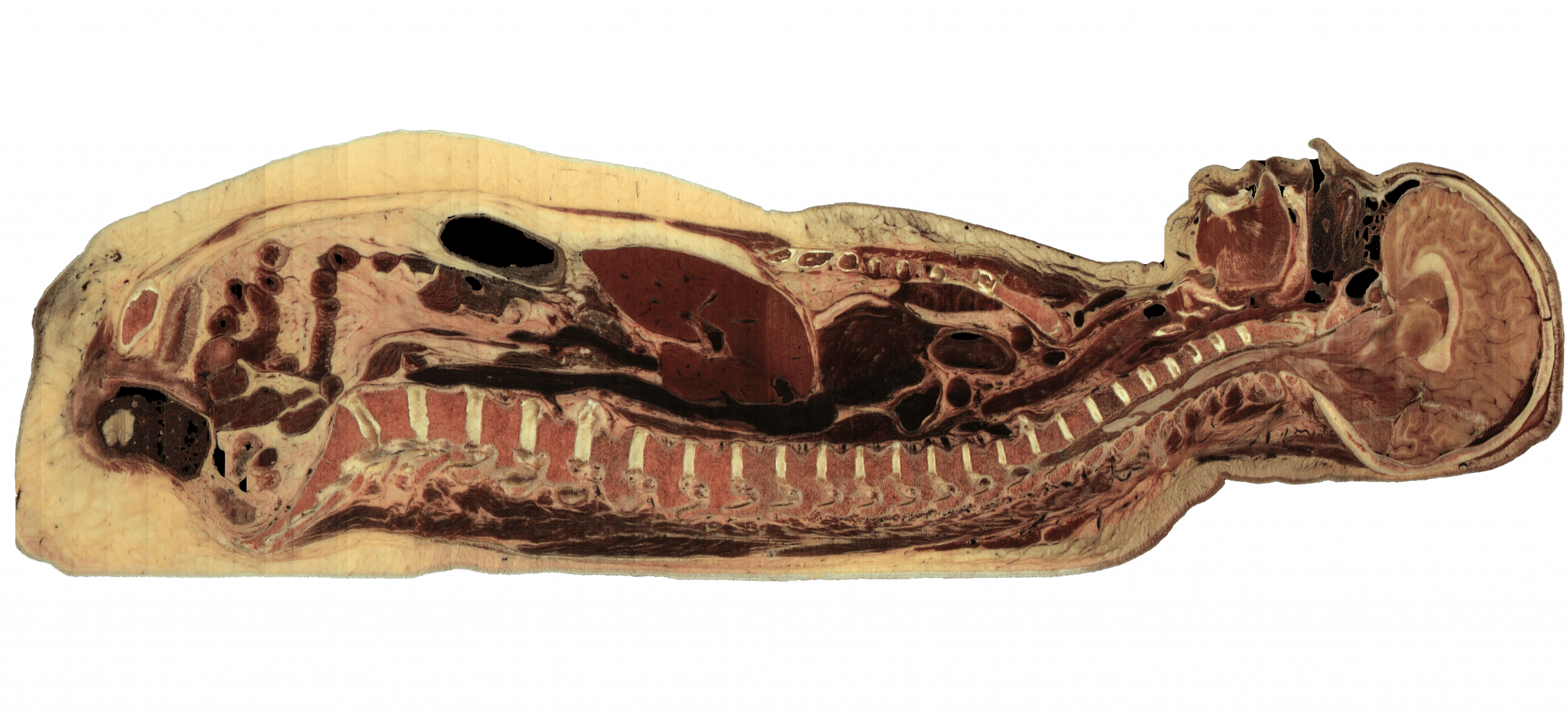
High-resolution anatomical images are integrated with the reconstructed internal anatomy to reproduce the natural colour, texture, and appearance of organs, muscles, blood vessels, nerves, and connective tissues. This process preserves the visual characteristics of real human anatomy throughout the internal structures of the digital body.
Anatomical Segmentation
Our segmentation specialists meticulously segment individual anatomical structures into discrete digital components. Bones, muscles, organs, arteries, veins, nerves, ligaments, fascia, and connective tissues are independently delineated while preserving their natural spatial relationships, each becoming an individually interactive component within the digital body.
Surface Reconstruction
The external body surface is reconstructed independently from the internal anatomy using surface topography datasets. High-resolution colour information is integrated to accurately reproduce skin texture, anatomical landmarks, and external morphology.
The annotated, segmented, reconstructed, and textured anatomical structures are integrated into a hierarchical Cadaviz Body architecture. Each component retains its geometry, spatial coordinates, metadata, anatomical relationships, and visual properties — creating a complete digital representation that supports advanced educational and clinical applications.
Interactive Visualization
The completed digital bodies are delivered through the Cadaviz virtual dissection table, enabling real-time exploration, manipulation, and virtual dissection. Every anatomical structure is reconstructed as an interconnected digital component, preserving the continuity of arteries, veins, nerves, and other anatomical networks from their smallest branches to their major pathways.
Cadaviz also supports dynamic anatomical simulation through the integration of physiological and functional models. Features such as cardiac motion, musculoskeletal movement, neural pathway visualization, and developmental anatomy extend the Cadaviz body beyond structural anatomy, creating an interactive environment for education, research, and clinical training.
From Human Legacy to Medical Innovation.
Connect with the ImmersiveLabz team to explore how Cadaviz Technology can transform your anatomy curriculum.
Schedule a Demo